
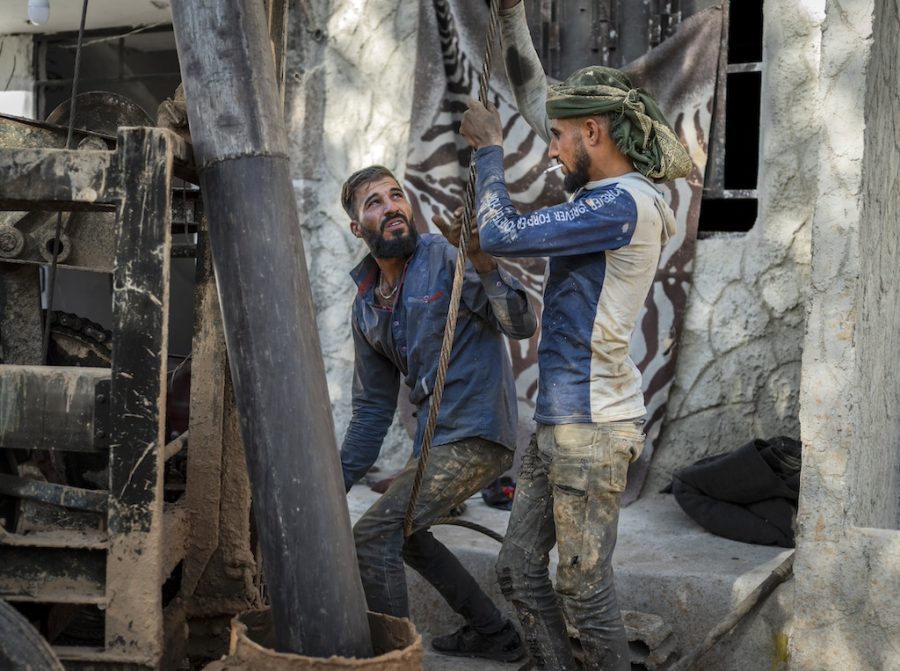
Reporting from Yarmouk — the devastated Palestinian refugee district on the edge of Damascus — Jacobin follows the Palestinian House, a grassroots reconstruction initiative, as it leads efforts to dig wells and restore water in a camp abandoned by the state.
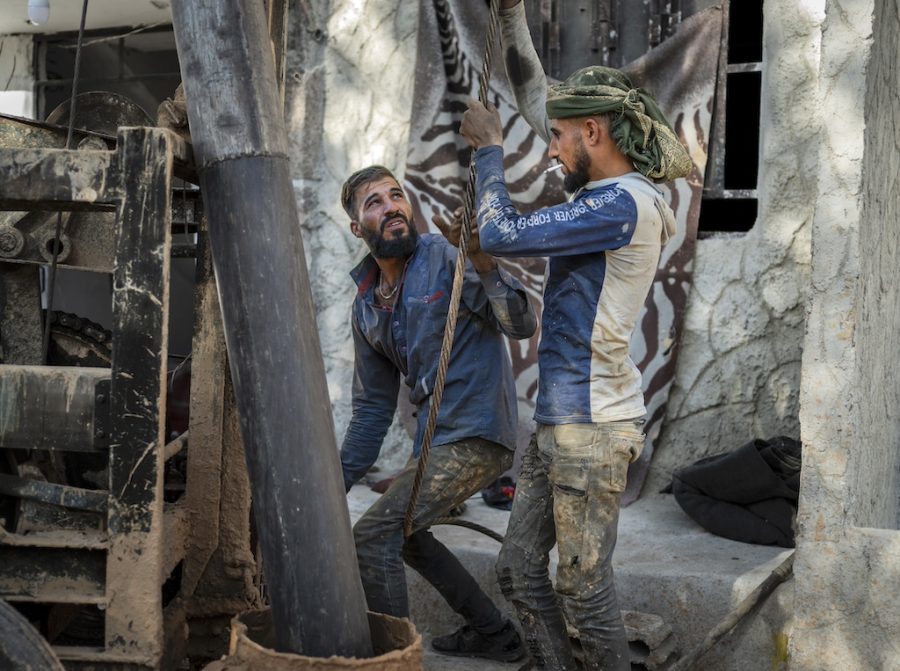
“This is pure gold,” says Khaldoun al-Mallah, holding up two bottles of cold water he bought in a shop rebuilt from the ruins of a neighborhood still struggling to recover, where electricity is scarce and the heat is relentless. With no fan to cool the room, Khaldoun spends hours in his office planning strategies to deal with the socio-environmental collapse weighing on the Palestinian refugee camp of Yarmouk — often compared to Gaza. Located south of Damascus, the camp was founded in 1957 by Palestinians displaced by the Nakba. For decades the community prospered, but the Syrian War that began in 2011 dragged Yarmouk into a deep abyss. Nearly a year after the fall of Bashar al-Assad, the country is still far from resolving its main structural problems under the new government of Ahmed al-Sharaa. The most pressing matter of all is water.
Khaldoun was the last surgeon to remain in the camp during the challenging years of the Yarmouk siege. After six years of exile in Idlib, he returned to help found the Palestinian House, a local organization that aims to rebuild the neighborhood and bring the community back to life.
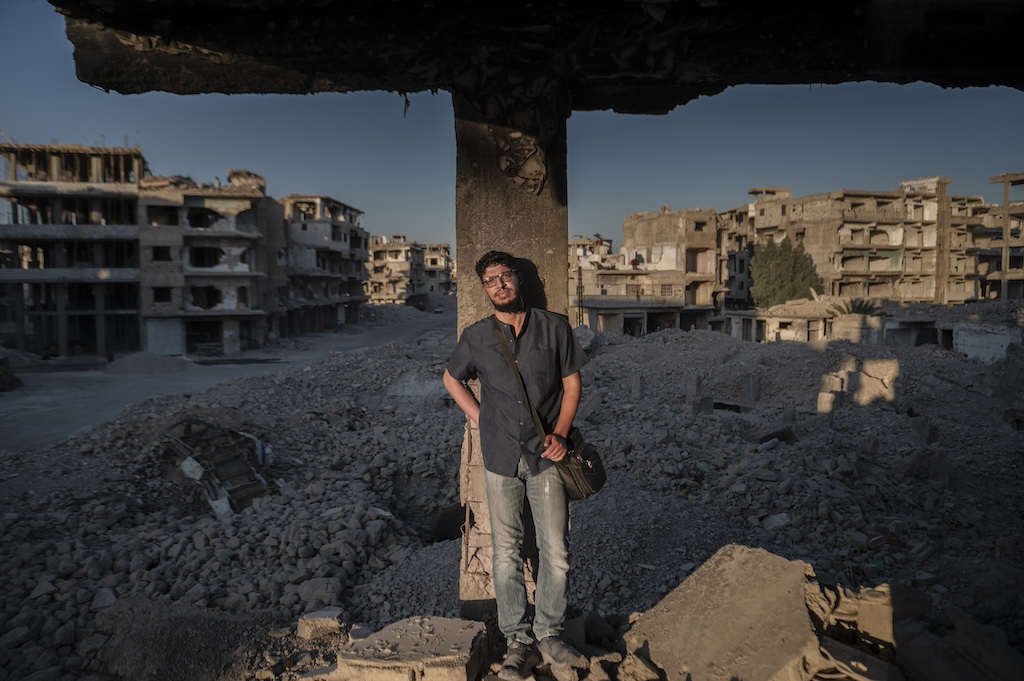
“I feel responsible for rebuilding our Little Palestine from the ruins,” says the forty-three-year-old Palestinian surgeon, whose reputation has been forged in years of hardship and resistance. The roar of machinery fills the air, replacing the thunder of bombs that once coated the camp with dust and rubble. “Without water, there is no life,” he tells Jacobin. “If we restore access to water, we will take a huge step toward reviving our homes.” For him, this is no longer just a project, but a purpose. The camp is no longer officially off-limits, but the devastation has rendered it uninhabitable. “I never imagined finding the city in such a pitiful state,” he says. “The infrastructure no longer works. We are completely disconnected from the drinking water network, and the damaged sewage pipes are contaminating the extraction and purification lines.”
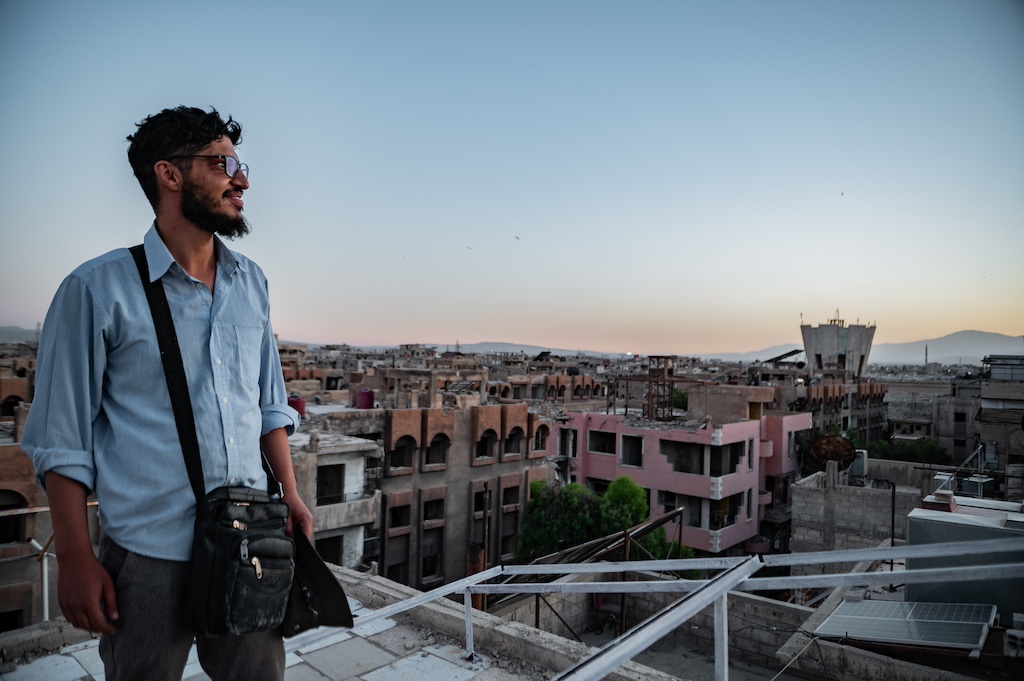
Although the war was brutal, with daily bombings, “a large part of the destruction happened after 2018, when an agreement with the regime forced the remaining survivors to evacuate to Idlib,” he explains. “A demolition army came to loot everything from the houses — steel and other materials, including the water pipes. That’s why not only the main pipelines are unusable, but all the internal systems of the houses are missing as well.”
Despite Yarmouk’s uninhabitable condition, the pull of return has grown stronger. “People are coming back partly because they can’t afford rent in central Damascus, but also because we Palestinians have a very strong bond with our place — we don’t want to repeat the Nakba.”
Water as a Weapon of War
Sitting on top of a pile of bricks, Khaldoun recalls how people in the camp “used to look for alternative ways to extract water, because even humanitarian organizations weren’t allowed free access.” Without these improvised sources, he says, “death awaited us. Many patients arrived showing signs of dehydration,” especially after Assad sealed off the camp at the end of 2018. “We endured for months without humanitarian aid, which caused hundreds of deaths from hunger and thirst.”
Amid the constant bombings and ISIS attacks, Khaldoun managed to keep the Palestine Hospital functioning. For six years, the twenty thousand inhabitants who stayed in Yarmouk received free medical care there despite a total lack of supplies. Out of desperation, residents drank whatever water they could find, exposing themselves to diseases like typhoid due to the absence of proper purification. “Those years trained us to face the challenge of scarcity,” he reflects. Because of chemical contaminants from the bombings and leaking wastewater, any use of untreated water is now impossible: “Every available source in this area is contaminated,” he explains.
Near the entrance to the camp, the Yarmouk Committee meets daily. Neighbors gather to discuss various problems — the most urgent of which is access to water. Abu Muhammed Ramez, head of the committee, explains that they have “twelve large municipal boreholes, but most are destroyed, and the cost of repairing them is in the millions.”
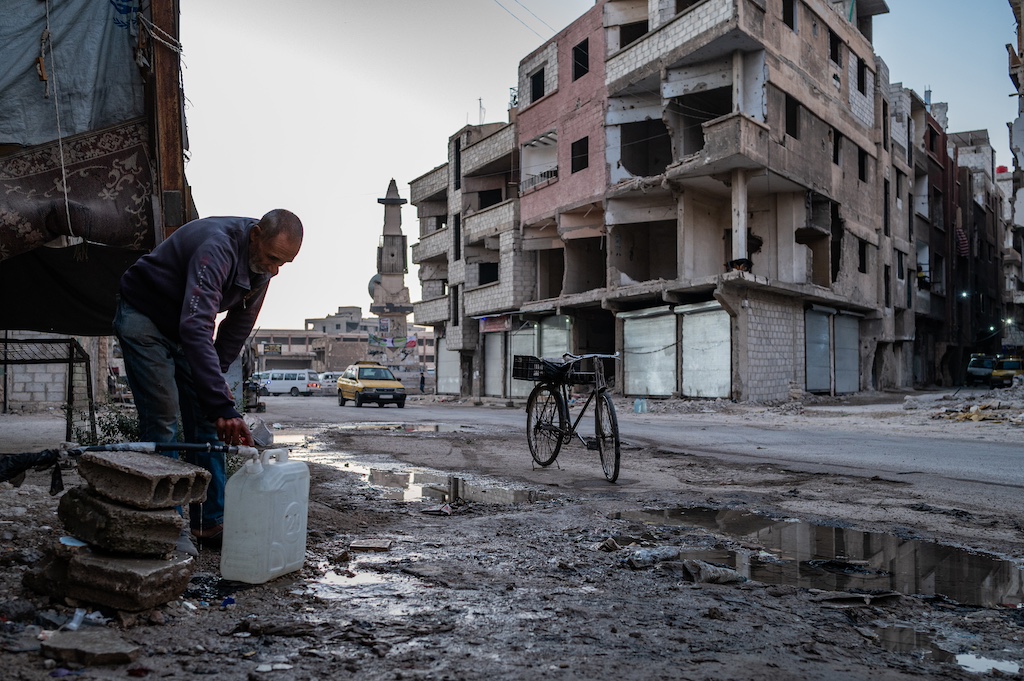
“For now, most people survive by turning to alternative sources such as refills from tanker trucks or individual initiatives. Some walk kilometers carrying plastic containers to fill them with drinkable water,” he says. Everyone depends on improvised wells, tanker trucks, and rudimentary systems for collecting and filtering water — leaving even basic needs a daily struggle.
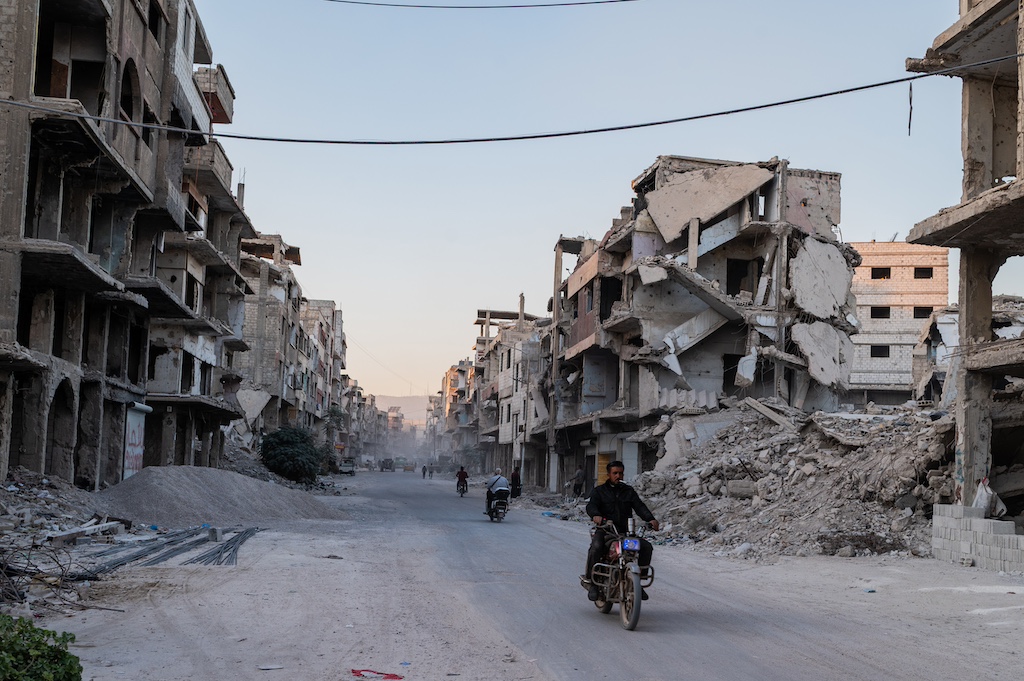
“Often, the problem is that to run the pumps for potable water, we need electricity, which usually isn’t supplied at the same time as the government’s water distribution,” he adds.
“In government offices, there’s a plan to rebuild all of Yarmouk’s infrastructure, starting with the water supply lines — but there’s no money,” Khaldoun says. “Many of these projects were assigned to NGOs, but so far we haven’t seen any of them working on the ground.”
The Geopolitics of Thirst
Water scarcity has become a profound humanitarian emergency, exceeding the region’s already harsh environmental conditions. Syria experiences chronic water stress — using more than 80 percent of its renewable water resources — but state mismanagement, the legacy of war, and ongoing geopolitical conflicts have all intensified the situation. The impact on agriculture, mostly small-scale and subsistence farming, has made the country’s reconstruction even more challenging.
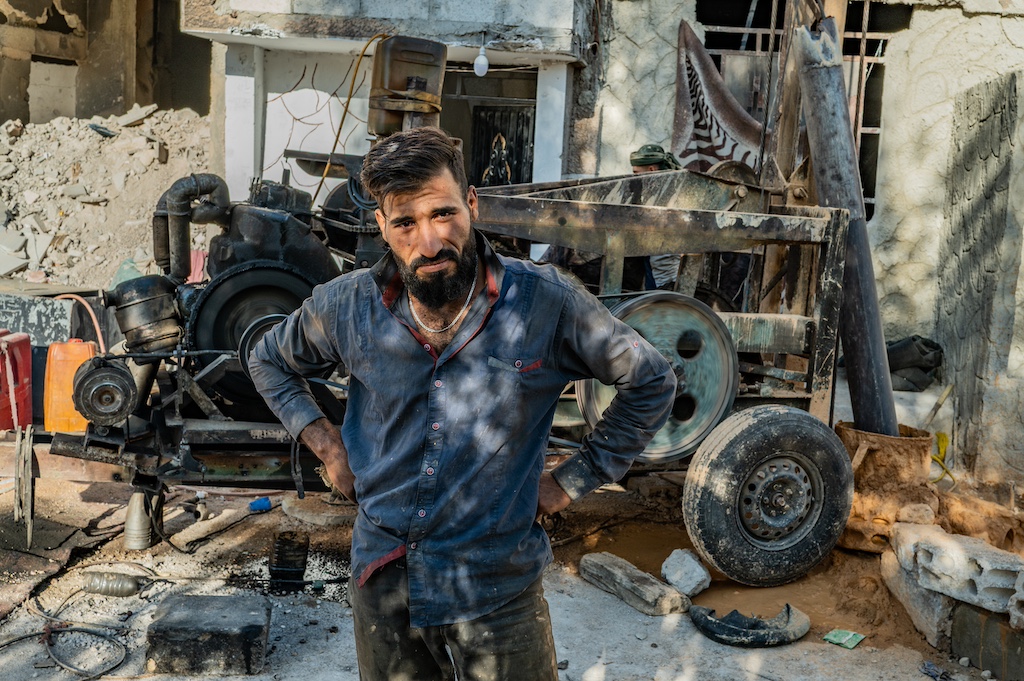
While conducting water quality tests at a borehole, Zeina, a thirty-seven-year-old humanitarian worker specializing in WASH (Water, Sanitation, and Hygiene), explains that “in Damascus, almost all the water is extracted from the al-Fijeh aquifer, but this year was extremely hot and there was a significant drop in the river flow, forcing the government to further ration water distribution.” This year, she says, “water production was far below what is necessary for life.” At the same time, she adds, it has become increasingly difficult for humanitarian organizations to offer solutions on the ground. “Trump cut USAID programs and Europe has reduced the global funding for NGOs — especially for Syria, where the budget cuts are severe. It means they can’t even afford to dig a single potable water borehole.”
Geopolitical conflicts continue to compound the crisis. “Turkey maintains illegal control over the flow of the Euphrates River for its own interests in the Tishrin Dam, held by the Kurds, which has devastated irrigation channels,” she explains. “Israel, meanwhile, controls 30 percent of the region’s water resources in the Golan Heights, depriving Syrians of access,” she adds, referring to a new cycle of occupations in southern Syria.
Grassroots Solutions
Facing these difficult conditions, the Palestinian House is working to rehabilitate wells and mills, support the reconstruction of homes, and restore a sense of community dignity through cultural and sports activities — all amid the state’s abandonment.
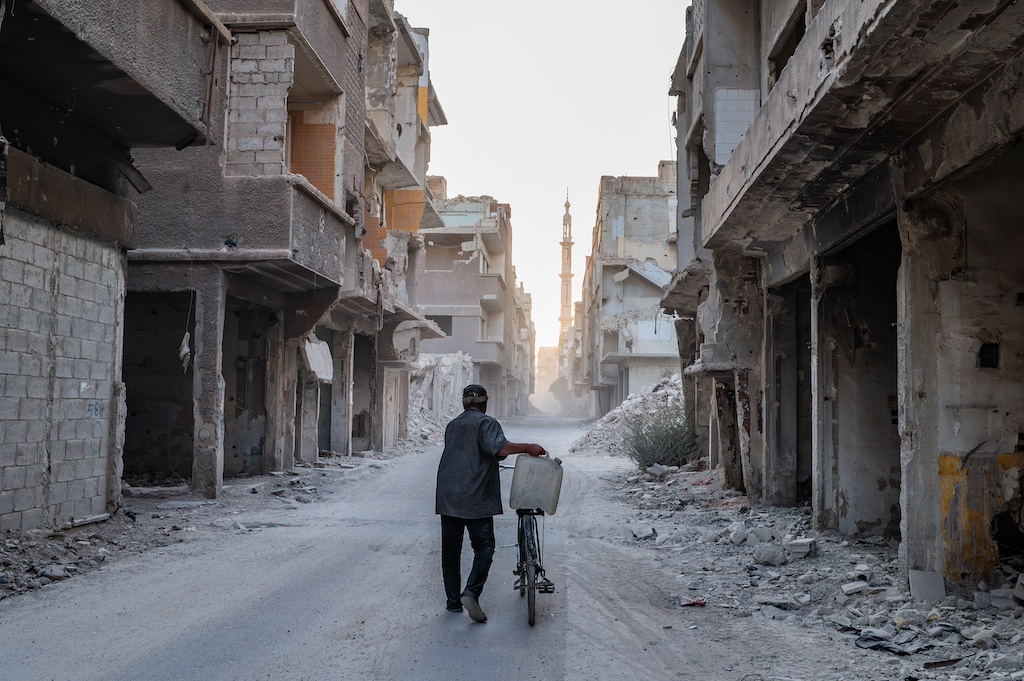
“First of all, we’re a politically independent organization — we don’t belong to any faction, party, or government; we’re purely grassroots,” Khaldoun explains. “Among our forty-six active members, we try to cover the four pillars our organization is based on: services, education, health, and empowerment.”
“It’s urgent to bring water into the homes — to help those already here and to encourage the repopulation of Yarmouk,” he says. “That’s why we’re dedicating enormous efforts to building boreholes with the few resources we have.”
“So far, we’ve dug two wells that together supply more than fifty families, and we’re now working on a third. Each one costs around two thousand dollars. The more money you have, the deeper you can go — and the better the water quality and volume, so it lasts longer,” he says. Through steady collaboration and small-scale innovations, they are slowly expanding access to water.
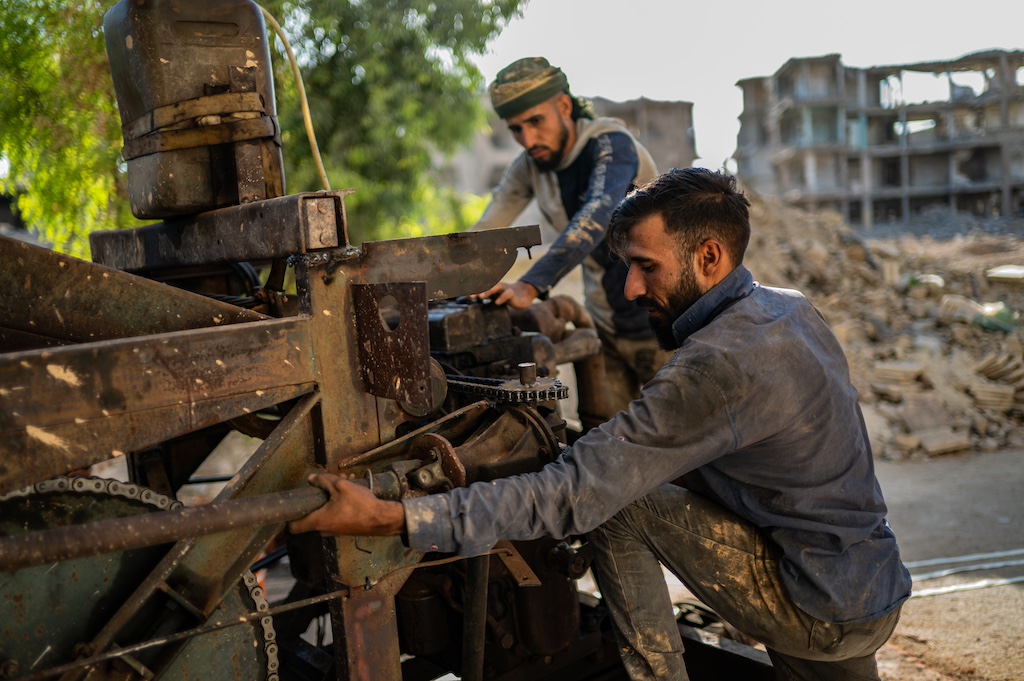
Those who have water in their homes owe it to self-managed cooperative initiatives. “Our project isn’t the only one,” he adds. One example is Abu Ahmed, age fifty-two, who used his own money to build a borehole that feeds a sprawling web of plastic pipelines and red tanks between buildings. “I believe water is for everyone — it should be free,” he says from the roof of his building, which is full of solar panels to run the water pump.
For Ahmed and his wife, returning to Yarmouk was more than a choice — it felt like a duty after enduring so much under the previous regime. But when they came home, they found only destruction. “They stole everything,” he says. “They broke the walls to take the pipes and sell them to businessmen who made fortunes from those materials,” he adds, referring to Mohammed Hamcho, a notorious Assad-aligned oligarch who profited heavily during the war.
Seeds of Renewal
The deeper one walks into Yarmouk, the more desolate it becomes. The sun seems to dissolve into the darkness rising from the ground. At the end of Palestine Avenue, the Saad family lives in a narrow alley. The father, Ahmad, gets up every morning to pray at the nearest mosque. He takes two jerricans with him to fill at a tap that still provides drinking water before going to the market in Yalda, where he sells vegetables. Just a few meters from their door sits a borehole built by the Palestinian House, pumping water directly to their rooftop.
“We built this ourselves,” says Khaldoun. “We chose this spot as if we were watering life among the rocks. Every small spark of light between these buildings has appeared since the fall of the regime — our goal is to multiply them.” Most people, he explains, don’t return because there’s no water, “so we’re digging as many wells as possible. Since we built this one, five families have returned to this remote corner,” he adds proudly.
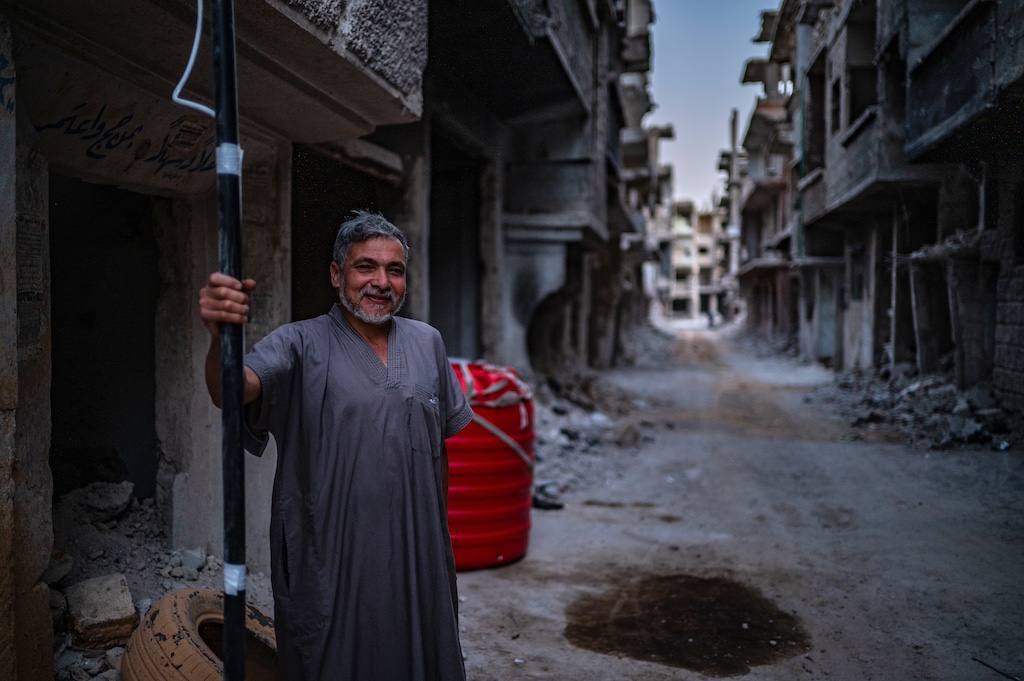
Sitting beside him is Ahmad Saad, a fifty-year-old vegetable vendor. “Water is very expensive, and our salaries are low,” he says. “For the last three years, we paid more than half our income just to fill the tank — around ten dollars every week.”
“Now, with the well, water is several times cheaper,” he adds with a smile. “We just have to rent a generator and pay for the fuel. Government electricity doesn’t reach this area, so we only have batteries and solar panels — but they aren’t powerful enough to run the pump for the thirty minutes it takes to fill the five tanks.
Fatima, his forty-nine-year-old wife, chimes in as she pours tea, “Now that we’ve solved the water problem, the next challenge is buying our own generator to keep the well running. We hope to fix everything step by step. We got used to living under siege, so we live thinking only about the next two days.”
Every day, around four in the morning, Khaldoun finishes his work. “These are temporary solutions,” he admits, “meant to deal with an immediate crisis and make life a little easier. But for true reconstruction, we need the help and funding from the government, major NGOs, and the international community.”
Despite the odds, the Palestinian House has become an example of self-organization in the midst of the deep spatial inequalities produced by Syria’s political economy. The water crisis in Yarmouk is not simply an environmental problem but a symptom of the multidimensional structural crisis faced by Palestinian and Syrian residents in the postwar period — where solving the water problem is only step one. Today, Khaldoun says, “every drop of water extracted from the arid soil of Yarmouk is a message: no devastation can defeat us.”